
If you design logos for a living, or hire a designer to create a logo for you, there’s a legal landscape you simply can’t afford to ignore. Intellectual property law governs who owns a logo, who can use it, and what happens when someone else tries to steal, copy, or register something confusingly similar to it. Get it wrong and the consequences range from expensive rebrand jobs to full-scale legal battles.
This guide draws on two in-depth interviews from the Logo Geek Podcast: one with Gordon Firemark, a practicing attorney specialising in entertainment, media, and intellectual property law (Episode 33), and one with Marcella Dominguez, a trademark attorney based in El Paso, Texas (Episode 78). While both guests are US-based lawyers, the principles they explain translate directly to the UK context, and where the UK picture differs, this article flags it clearly.
Copyright vs. Trademark: What’s the Difference?
The most fundamental question any logo designer or business owner should understand is the distinction between copyright and trademark protection, because they cover very different things.
Gordon Firemark explains it well: “A copyright is a protection for the design, the artwork, the expressive, creative originality that goes into creating something like that, and it protects against copying of that design of the logo, and it being used and incorporated into other kinds of works.”
Trademark protection, he says, is a different flavour entirely. “When we deal with logos, of course it is a distinctive symbol or mark of some sort that’s being used as a brand identifier, and so what the protection gives us is the right of the owner of that mark, the user of that branding, to have exclusive right to use it in connection with those kinds of goods or services as a brand or source identifier.”
In simple terms: copyright stops people from copying the artistic design; trademark stops people from using the same or confusingly similar mark to identify competing goods or services.
Firemark offers a useful example to illustrate why both matter: “Copyright law wouldn’t stop somebody else from using something similar to identify their own goods or services that are competitive in the marketplace. Trademark law goes as far as anything that is confusingly similar.” So a basic geometric shape, say, a red triangle, might not qualify for copyright protection on its own, but could still be protectable as a trademark.
In the UK
In the UK, copyright arises automatically the moment an original creative work is produced. You do not need to register it. Under the Copyright, Designs and Patents Act 1988, the creator of an original artistic work (including a logo) owns the copyright from creation. There is no registration system for copyright in the UK, it simply exists.
UK trademark registration is handled by the Intellectual Property Office (IPO), and unlike copyright, it must be actively applied for. A registered UK trademark gives the owner exclusive rights to use that mark in connection with the registered goods and services classes, and importantly, it gives them the legal tools to stop others from using a confusingly similar mark.
Below is the logo I designed for Trade Mark Wizards, a company I personally use for trademark advice here in the UK.

Who Owns the Logo Copyright: The Designer or the Client?
This is one of the most commonly misunderstood aspects of logo design, and getting it wrong can have serious financial consequences for both parties.
Gordon Firemark is clear: “A designer can own a copyright in a design he or she creates, because they’re doing the original work to create it, but unless that designer is using that mark to identify his or her own services or goods, they’re not the owner of the trademark, the client for whom they’re creating that work is the owner of the trademark.”
This means that by default, the designer owns the copyright in the logo they create. The client owns the trademark rights (once they register it and use it in commerce). If a client wants to own the copyright outright, which is standard practice, that ownership must be formally transferred.
Firemark’s advice: “Retain ownership of copyright in the image at least until they’ve been paid in full for the design work.” This is essential protection for designers. Don’t hand over copyright until the invoice is paid. My advice; only transfer over copyright for the final agreed logo, that way you can repurpose or sell any unused designs.
In the UK
Under UK law, where a designer is commissioned as a freelancer (rather than an employee), copyright belongs to the designer unless there is a written agreement transferring it to the client. This is a critical distinction… many clients incorrectly assume that because they paid for the work, they automatically own it. They don’t, unless the contract says so.
A written assignment clause, clearly stating that copyright transfers to the client upon receipt of final payment, is therefore essential in every logo design contract.
Transferring Copyright: What Does a Good Agreement Look Like?
Firemark describes a formal copyright transfer as an “assignment of copyright”, though it doesn’t need to be complicated. “The specific language of a transfer of ownership is usually in the context of the document we call an assignment of copyright, and it’s relatively simple. It’s about three quarters of a page of typed text when we lawyers do it. The fact of it is, in your engagement contract, it could be as little as two or three sentences.”
The key terms to include in any copyright transfer clause are:
- A clear statement that all intellectual property rights in the final design are assigned to the client
- The trigger for that transfer (typically, receipt of full payment)
- Confirmation that the designer retains rights to display the work in a portfolio
Graham Smith over at Smithographic, has a useful copyright transfer template designers can adapt.
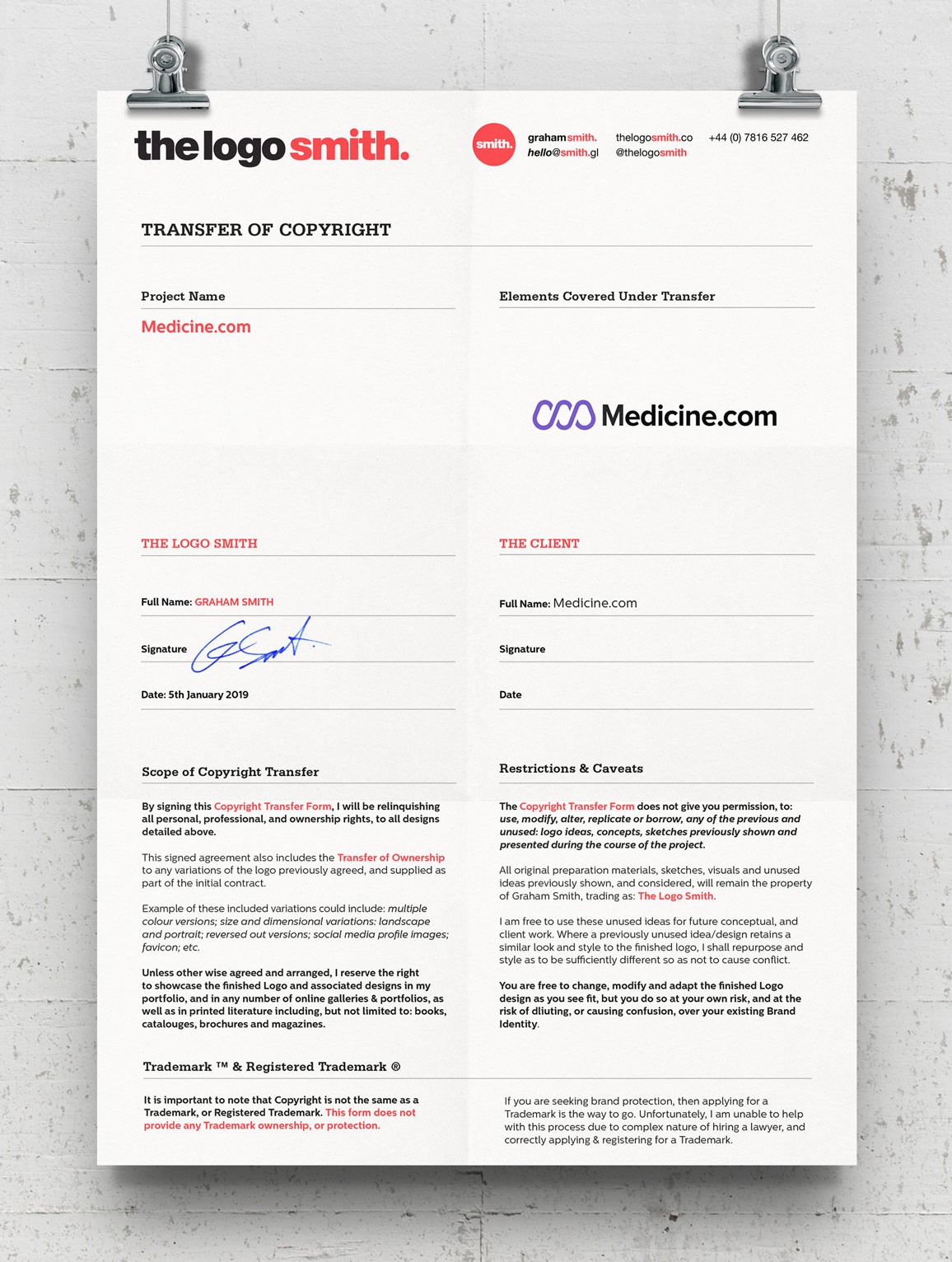
If you commission subcontractors as part of your design process, Firemark also recommends a specific clause: “The way to do it is to use a contract that provides the subcontractor will be doing their work as a work made for hire for you… that means you own the copyright on it, so you can transfer it to whomever you need to.”
Why Registering a Trademark Matters (More Than You Might Think)
Copyright protects the design. But it’s trademark registration that truly locks down a brand identity in the commercial world. Here’s why it matters, from both sides of the designer-client relationship.
Marcella Dominguez puts it plainly: “If you’re definitely going to be visiting a graphic design agency or a graphic designer to help you with your branding, then that branding agency or logo designer should at the very least be recommending that you also seek the advice of a trademark attorney. Not so much because you’re going to jump on registering the trademark right away, but because you want to make sure that that design or that name or slogan that you guys have chosen is not in conflict with anything else out there that already exists.”
Her analogy is apt: “It’s kind of like looking at a weather forecast just to see what you should wear for the day. You want to make sure that the freeway is clear, that there’s not going to be any trouble moving forward.”
The cost of not doing this upfront can be severe. As I recount from personal experience in that same interview: “I actually just had a client that was close to going ahead and actually proceeding with the logo and they hadn’t yet had their name trademarked. Thankfully, just before I was about to kick off the project, they realised that they couldn’t register the name that they asked me to work with.”
The result? A complete restart, wasted time, wasted money, and a frustrated client.
The Trademark Registration Process in the UK
In the US, trademark applications are filed with the USPTO (United States Patent and Trademark Office). In the UK, you apply through the Intellectual Property Office (IPO).
The process follows broadly similar steps to those described by Gordon Firemark for the US:
- Search for conflicts – before filing, check whether a similar mark already exists
- Choose your classes – specify the goods and services the trademark will cover
- File the application – with the relevant registration fee
- Examination – the IPO reviews distinctiveness and checks for conflicting marks
- Publication – the mark is published in the Trade Marks Journal, giving third parties a window to oppose
- Registration – if no opposition is upheld, you receive a registration certificate
Marcella Dominguez emphasises how important accuracy is at the filing stage: “You have to be very precise about what identification you are selecting because that is the category in which you are going to be protected.” She gives the example of a restaurant that also sells merchandise: “You’re not going to be protected in merchandise if you accidentally selected restaurant services, even though you are a restaurant selling merchandise.”
This is exactly the kind of nuance that makes professional guidance valuable.
How Long Does It Take?
Dominguez is refreshingly direct on timeline: “It takes anywhere between 11 to 14 months. I’ve heard other people say it’s six months. This is what I do every single day. There is no way that it takes six months.”
In the UK, the IPO aims to examine applications within 20 working days of filing, but the full process including the opposition period typically takes several months to a year or more, depending on complexity and whether any objections are raised.
Registering the Name vs. Registering the Logo: They’re Not the Same Thing
A common misconception is that registering a company name protects your logo, or vice versa. Dominguez is explicit: “You would need to register both the company name and the logo separately. Yes, so that would mean that there are two applications.”
Registering in Black and White
For logo registration, Dominguez offers practical advice: “If you know that you’re going to want to be changing the colours, you should definitely just register your logo in black and white because then that allows you to change colours moving forward and still remain protected in the design.”
This is especially relevant for designers who create multiple colour variations of a logo. Register in black and white, and all colour applications of that same design remain protected.
Trademark Classes: Why Getting This Right Matters
Trademarks are registered within specific “classes” of goods and services, based on the Nice Classification system (used internationally, including in the UK). There are 45 classes in total.
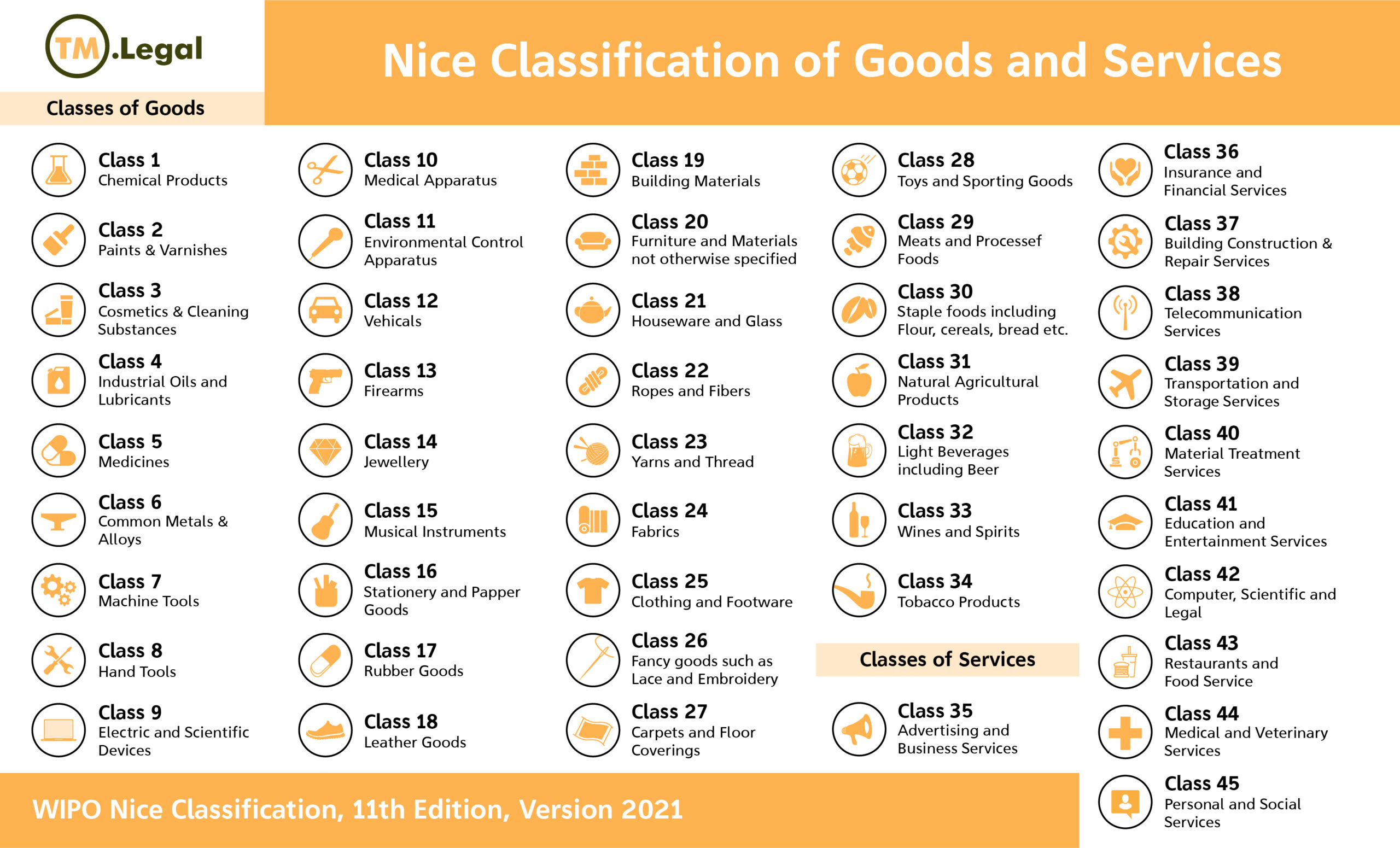
Dominguez describes a situation that trips up many DIY applicants: “Let’s say you are selling t-shirts. If you accidentally choose restaurant services because you’re a restaurant that actually wants to sell merchandise, you’re not going to be protected in merchandise. Even though you are a restaurant selling merchandise, what you are selling is clothing.”
If your business spans multiple categories, such as a software company that also sells branded merchandise and runs events, you may need to register across several classes to be fully protected. Local councils in the UK, for example, often register iconic marks across numerous classes to ensure comprehensive coverage. This is something a trademark attorney is well-placed to advise on.
How Different Does a Logo Need to Be to Avoid Infringement?
This is one of the most common questions designers ask, and one of the most nuanced to answer.
Gordon Firemark explains the two legal standards at play. Under copyright law: “The standard is substantial similarity, if a viewer is going to look at this thing and say, ‘Oh yeah, that’s just like the Adidas logo,’ then that’s going to be enough.” Under trademark law: the test is “confusing similarity”, whether a member of the public is likely to be confused about which company is behind a product because of the logo applied to it.
On the famous Adidas three-stripe example, Firemark clarifies: “If it’s vertical stripes, or if each of them’s a different colour, we’re talking about something different. It’s certainly not infringing a copyright, because lines, even diagonal lines, are not original and entitled to copyright protection, but they might be entitled to the trademark.”
The honest answer is that there’s no bright-line rule. The closer a design is to an existing registered trademark in the same industry, the greater the risk, and the only reliable way to assess that risk is to conduct a thorough search and, ideally, consult a specialist.
When Big Brands Use Their Legal Power as a Weapon
Firemark is candid about the reality of large corporations pursuing small businesses: “I think it gives someone or a company the power to be a bully. If you can afford a lawyer and they can’t, that letter from the lawyer is very frightening for the one who can’t afford representation.”
That said, brands do occasionally miscalculate: “Every once in a while, someone stands up on principle and says, ‘I’m going to fight this anyway because it’s wrong.’ Every once in a while, it works against the brand.”
One such example is when Apple initiated legal action against a five-employee startup, Prepear, an app for cooking recipes. They said; “We are a very small company with only five team members, and the legal costs of our fight for the right of all small business owners to be able to develop their own logo without fear has already cost us many thousands of dollars and the sad layoff of one of the team members. We are defending ourselves against Apple not only to maintain our logo, but to send the message to big tech companies that bullying small ones has consequences.”
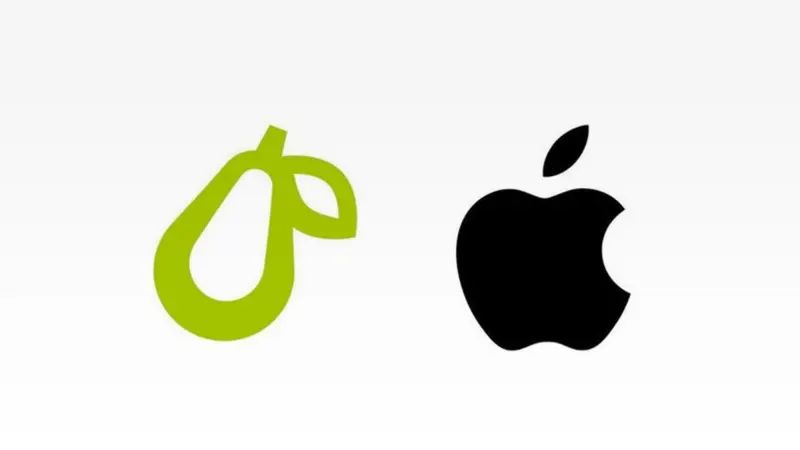
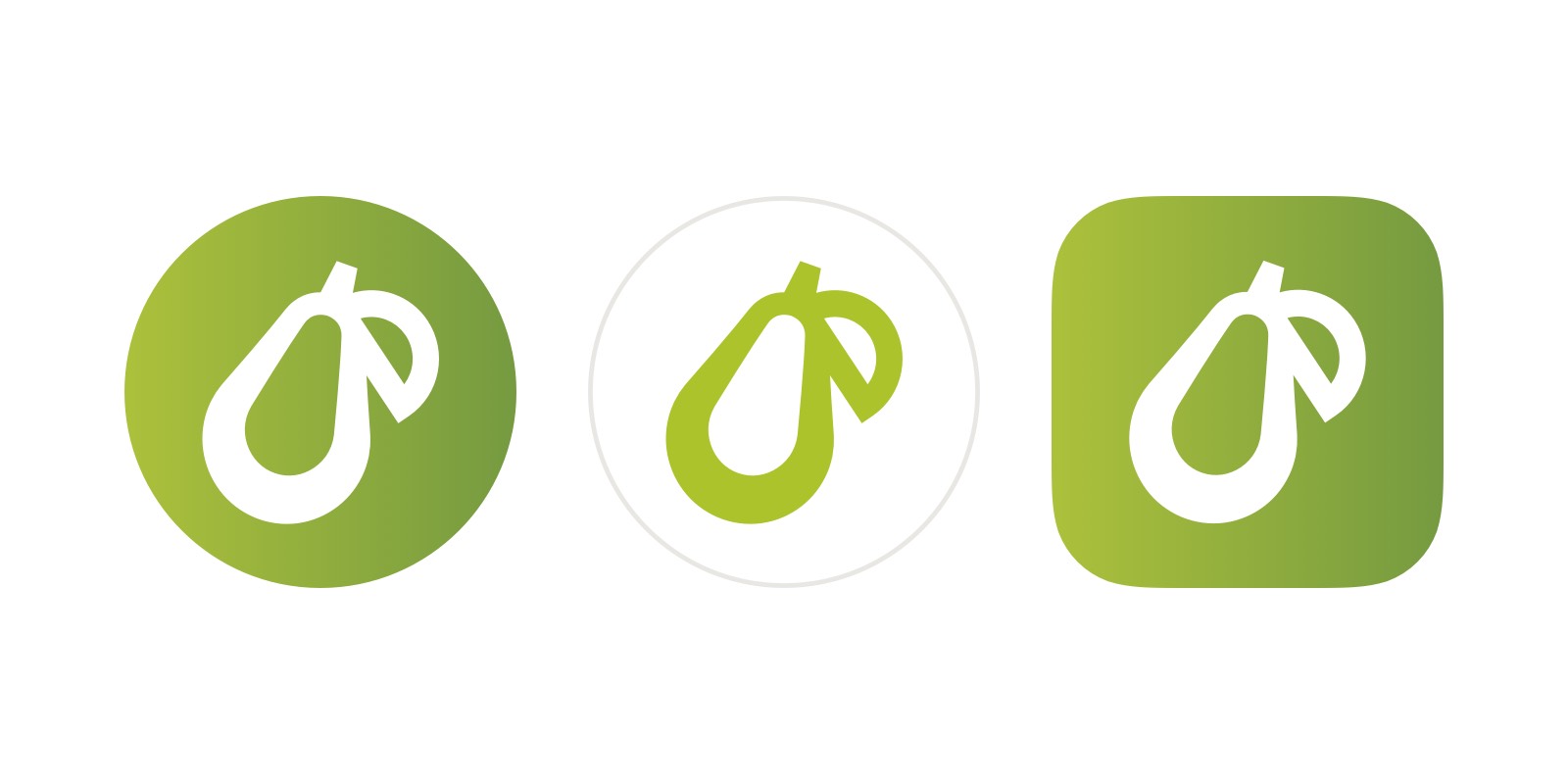
In this case, Prepear settled the trademark dispute by making a minor change to its logo. As you can see it was the leaf that caused the issue.
If you receive a cease-and-desist letter as a designer or a client, don’t panic, but do seek legal advice before responding. How and whether to engage is a strategic decision, not just a legal one.
What to Do If Your Logo Is Copied
If Your Work Is Being Passed Off as Someone Else’s
Designers often encounter their portfolio work being claimed by others online. Firemark explains: “You can do a cease and desist letter, tell them to stop it and demand that they do so. In the US, we have the Digital Millennium Copyright Act (DMCA), a take-down procedure. It works for images as well. If somebody has posted a portfolio of their work and your work is in it, you can have that image taken down just by notifying the operators or the host of the website.”
In the UK, similar take-down mechanisms exist through the platforms themselves, and under UK copyright law you have the right to bring a claim for copyright infringement. The UK also has its own framework under the Copyright, Designs and Patents Act 1988.
If a Competitor Is Using a Confusingly Similar Mark
Firemark advises: “When you encounter a situation of infringement, it’s important to consult with a lawyer. You can reach out to the other party with a notification: ‘Hey, we have a registered trademark, or we’ve been using this brand for our business for these many years.’ Oftentimes, you can work out a solution, especially if you’ve notified them early enough in the other mark’s life.”
If that fails: “We can send a cease and desist notice, a letter basically demanding that they stop and explaining the consequences if they don’t. If that doesn’t work, then we have decisions to make about whether to proceed with litigation.”
Dominguez reinforces the importance of active “policing” of your trademark: “If you don’t do the policing afterward, you run the chance that you might lose it. All that work and money that you invested in to try and protect your mark is essentially gone.”
The TM, ®, and © Symbols: When to Use Each
There is widespread confusion, and misuse, of intellectual property symbols in logo design. Here’s the definitive breakdown.
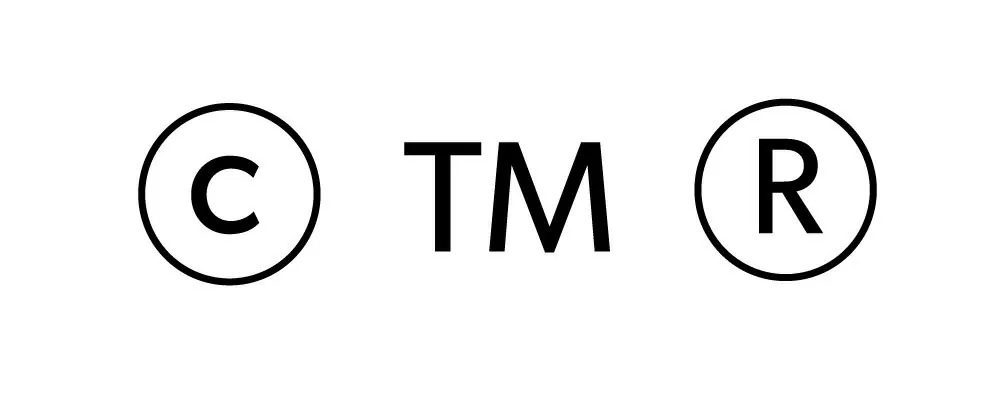
© (Copyright)
Indicates copyright ownership. In the UK, copyright arises automatically so you don’t need to register to use this symbol. You can place it on any original creative work you’ve produced.
™ (Trademark / Unregistered Mark)
Marcella Dominguez explains: “The TM is basically a placeholder for when you do not have a registration yet. It could mean that you’re just using it because you’re testing it out, but nonetheless, you’re claiming ownership over that design or name or whatever it is that you’ve put the TM on.
® (Registered Trademark)
This is the one that requires care. Dominguez is emphatic: “You can only use the circle R, the registration symbol, on something that has been registered. If you have not registered the logo, you cannot put a circle R on the logo. If you have not registered the name, you cannot put a circle R on the name.”
She also warns that misusing ® carries real consequences: “If you ever got to the situation where, God forbid, you’re being sued or having to sue somebody, they can always make the argument, ‘Well, they kind of didn’t care for it.'” Using the ® symbol incorrectly can actually undermine your legal position.
Firemark adds that registering a name and registering a logo are separate acts: “If you’ve registered the name and you’re writing a document and you’re writing the name of the company, you can use the R. But for the logo, in order to use the R on the logo, you have to register that logo separately.”
A practical note for designers: it’s surprisingly common for less experienced designers to include a ® symbol in speculative work or early drafts. This is incorrect and potentially misleading to clients. Only add ® once registration is confirmed.
Searching for Conflicts Before You Design
Before committing significant design work to a direction, it’s worth checking whether a similar mark already exists. This protects both the designer and the client.
In the US, the primary search database is TESS (Trademark Electronic Search System) at the USPTO. Dominguez recommends: “Type in USPTO TESS. That allows you to type in any business name, any slogan that you’re thinking of using, and it will populate a list of what’s already been entered into their database.”
In the UK, you can search the IPO’s trademark database. For international searches, use the Global Brand Database, which covers trademarks registered across multiple countries through a single system. If you’re a designer, I recommend using both for the widest search.
Firemark also mentions that visual search firms can search for similar logos, not just text marks, for a fee. For high-investment branding projects, this kind of thorough due diligence is well worth the cost.
Contracts: The Essential Protection for Every Designer
Both Firemark and Dominguez were clear that a solid contract is non-negotiable. Without one, designers have little recourse when things go wrong.
Dominguez frames the purpose of a contract succinctly: “A contract is more so for the unexpected than it is for the expected. It’s expected that you’re going to get paid. It’s expected that the work is going to be delivered within a certain time, but it’s really for the unexpected that you are preparing this document.”
She continues: “It’s harder to find a solution to a problem once you’re in the problem. If you prepare for the solution beforehand, it might be a smoother ride working through those hurdles.”
What a Good Design Contract Should Cover
Drawing on both interviews, a robust logo design contract should include:
- Scope of work – what is and isn’t included in the project
- Payment terms – amounts, schedule, and what happens if payment is late
- Intellectual property – who owns the copyright and when ownership transfers
- Revision policy – how many rounds of amends are included and what counts as a new brief
- Delivery timeline – expected dates and what happens if they slip
- Kill fee – what the designer is owed if the client cancels part-way through
- Subcontracting – if you use other designers, who owns their work
- Governing law – which country’s law applies (important if working internationally)
Can Emails Substitute for a Contract?
Dominguez confirms that email exchanges can carry legal weight: “If you don’t have a contract and you have been exchanging emails and it’s clear that you both have agreed to something, then there has been a meeting of the minds, which can be used in a court setting.” However, she’s clear that a formal written contract is always preferable, because it addresses eventualities that emails rarely do.
Firemark echoes this: “One of the values of having a contract is the formality of having a piece of paper that people have signed. We know there’s a seriousness to the transaction because there’s a contract, and that’s valuable.”
Using Templates vs. Hiring a Lawyer
Both guests give a pragmatic view on contract templates. Dominguez says: “The templates that are out there, they might work for you, but they might be leaving some things out. If you have a template that is generally for your industry, just make sure that it covers everything you are looking to cover your bases on. At least have an attorney look over it for you, that way you’re still saving the money, which is probably the reason you do a DIY template to begin with.”
Firemark agrees: “There comes a point in everybody’s business where they should go beyond the form they find online and have something that’s custom tailored to their own needs. This is a maturing industry, and the standards and practices are fairly well established, so it’s certainly not a giant legal expense to have a lawyer draw up a contract for your business.”
One important caveat for UK designers: most templates found online are written under US law. They may not fully comply with UK contract law, consumer regulations, or GDPR requirements. Having a UK-based solicitor review or tailor your contract is a sensible investment.
Key Takeaways for Logo Designers and Their Clients
For designers:
- You own the copyright in what you create as a freelancer – make sure your contract specifies when and how it transfers to the client, and not before payment is received.
- Never use ® on a logo unless it has been formally registered.
- Use ™ freely to indicate an unregistered claim.
- If you use subcontractors, ensure your contracts with them include a work-for-hire clause so you own the output.
- Get a proper contract in place before starting any project. Email threads are a poor substitute.
- Recommend to every client that they consult a trademark attorney before committing to a name or logo direction
For clients:
- Registering your company at Companies House does not give you trademark protection. You need a separate trademark registration for logo designs.
- Register both your business name and your logo separately; they require two distinct applications.
- Register your logo in black and white to preserve flexibility over colour.
- Be precise about which trademark classes you register in – the wrong classes leave gaps in your protection.
- Once registered, actively police and protect your mark; failing to enforce it can result in losing it
- Trademark registration in the UK typically takes many months – plan accordingly, especially if you’re launching publicly
Useful Resources
- UK Trade Mark Search: https://www.gov.uk/search-for-trademark
- WIPO Global Brand Database (international trademarks): https://branddb.wipo.int/
- Logo Geek Podcast Ep. 33 — Copyright & Trademark Law with Gordon Firemark: logogeek.uk/podcast/copyright-and-trademark-law
- Logo Geek Podcast Ep. 78 — How to Register a Trademark with Marcella Dominguez: logogeek.uk/podcast/register-a-trademark
This article is for informational purposes only and does not constitute legal advice. For guidance specific to your situation, consult a qualified solicitor or trademark attorney in your jurisdiction.