
For most of my career, I did what thought every logo designer did: I presented options. Three logos. Sometimes four. Each one fully developed, mocked up on stationery and signage, presented one after the other before summarising and gently steering the client toward my preferred direction.
It felt thorough. It felt professional. It felt like the right thing to do.
It wasn’t.
Over the past couple of years I’ve moved away from presenting multiple logo concepts entirely. Now I present what I believe is the solution… one logo, one direction, one answer to the brief. And it has genuinely transformed the quality of my work, my client relationships, and my satisfaction as a designer.
This post explains why I made the change, how my logo design process and client presentation now works, and what I’ve learned along the way. I’ll also draw on conversations I’ve had on The Logo Geek Podcast, particularly my interview with brand strategist Melissa Yeager, as well as the thinking of Sean McCabe/Wes, whose influential 2013 essay on the one concept approach sparked a conversation across the whole design industry. Sadly his article is no longer online, although you can still read the content through WayBack Machine here.
The Problem with Presenting Multiple Logo Concepts to Clients
Let me be honest about something. When I used to present three or four logos, I already knew which one was the right answer. There was always a strongest concept… the one that genuinely solved the client’s goals, that felt considered and complete. And then there were the others.
I wasn’t showing weak work. Every option I presented was a good logo. But if I’m being completely truthful with myself, I was often designing the solution and then creating two or three additional concepts around it, almost as a formality. It was a kind of professional theatre: a way of appearing thorough while the real answer was already sitting there.
This created several serious problems.
It put clients in the wrong role. A logo is not a consumer product to be chosen from a shelf. It’s a strategic tool. When you lay three options in front of a client and say “which do you prefer?”, you invite them out of objective, goal-focused thinking and into subjective mode. Suddenly they’re picking favourites. They’re noticing that they like the typeface on option A and the symbol on option C, and they’re wondering why you can’t simply combine them. As Melissa Yeager put it when we spoke on the podcast, presenting options “kicks them into subjective mode,” where the project goals evaporate and personal taste takes over.
Clients Frankenstein logos. When clients see multiple strong, viable directions, all genuinely good, they naturally want the best of everything. They start cherry-picking elements and asking you to merge them into one. But design doesn’t work like that. A great logo is a single idea executed brilliantly. When you force two separate ideas into one mark, both ideas suffer. The internal logic dissolves. I’ve produced my share of Frankenstein logos over the years, and every single one of them exists because I presented options in the first place.
Caused endless logo revisions. Presenting multiple concepts doesn’t just create confusion at the selection stage… it tends to generate revision cycles that have no clear endpoint. Because the client has been set up as the decision-maker from the start, they feel empowered to keep steering. The designer becomes a pair of hands rather than a strategic partner, and the project drifts further from the original brief with every round.
Was a form of throwing mud. When you show a client lots of different things and wait to see what sticks, you’re not acting as an expert. You’re hedging. You’re distributing responsibility for the outcome. This might feel safer, but it fundamentally misrepresents what design is, and what a skilled designer can offer. As Sean McCabe put it in his essay on the one concept approach, presenting multiple options is like a doctor suggesting several possible operations and asking the patient to choose. You don’t go to a doctor for options. You go for a diagnosis.
The Case for Presenting One Logo Concept
The one concept approach isn’t a new idea. It has roots that go right back to some of the most celebrated designers in history.
Paul Rand, widely regarded as one of the greatest graphic designers who ever lived, was famous for presenting a single solution to his clients. Steve Jobs recalled asking Rand to create several options when designing the NeXT logo. As per the video below, Rand replied: “No. I will solve your problem for you, and you will pay me. And you don’t have to use the solution… if you want options, go talk to other people.” That wasn’t arrogance. It was confidence in a process built on decades of expertise. Rand understood that the designer’s job is to arrive at the best answer, not to outsource that judgement to the client.
Sean McCabe articulated this powerfully for a new generation of designers in 2013, writing that design is an iterative process: you start with many ideas, refine relentlessly, and dismiss the less effective paths until one solution remains. He argued that if a designer has arrived at two concepts and genuinely cannot determine which serves the project goals better, the work simply isn’t done yet. That decision, which direction is strongest, is a design decision, and making it is your job, not your client’s.
His position is bold, perhaps deliberately so: “If you’re looking for options, I’m not your guy.”
Melissa Yeager discovered McCabe’s thinking and adapted it into her own practice with remarkable results. When I spoke to her on my Logo Geek Podcast, she explained something that resonated deeply with me. She said that presenting options doesn’t position you as the design expert. It positions you as someone who creates choices and then waits to be told which one to pursue. And yet clients come to you precisely because they don’t have that expertise themselves. The moment you present a menu, you’ve handed the authority back to them.
She also made a point that I’ve experienced first-hand: when you’re presenting multiple concepts, you end up spreading your best ideas across those options. One mark gets your best typographic thinking. Another gets your strongest symbol concept. A third gets an interesting colour approach. But none of them get everything. With a single logo concept, you can pour all of your thinking into one brand identity and go deeper, into applications, secondary marks, typographic systems, and the full visual language of the brand.
And there’s something else. When you commit to presenting one solution, the stakes are higher, and that pressure is a gift. You stop creating options that are “good enough” and start asking harder questions of yourself. Is this actually the best answer? Have I really solved the problem? That shift in mindset changes everything.
My Logo Design Process: How I Present One Concept
I’ve been refining this approach for a couple of years now, and my process has evolved considerably. Here’s how I typically work from brief to final logo presentation.
Step 1: Start with Brand Strategy
Nothing has changed here. Every project begins with a thorough briefing process, a deep conversation about who the client is, who their audience is, what they’re trying to achieve, and what their brand needs to communicate. I think of this as creating the goals for the project. These goals become the lens through which every subsequent design decision is made and justified.
Having a clear strategic foundation is what makes presenting a single logo concept possible: when you’re clear about what the logo needs to do, you have clear criteria for knowing when you’ve found the right answer. Without that strategy, you’re just making aesthetic decisions, and those are always subjective. With it, you can explain and defend every choice in terms of the brief.
Step 2: Explore Widely, Then Commit to One Direction
This is where my working method has changed most significantly. Previously, I’d develop several directions and present them all. Now, I use that exploratory phase differently. I sketch widely, consider many directions, and ask myself continuously: which of these genuinely best serves the goals we’ve established?
I abandon directions not because they’re bad, but because they’re not the best. That distinction matters enormously. It requires me to be honest with myself rather than hoping the client will make the hard call on my behalf.
Step 3: The Intermediate Check-In (When Needed)
One of the most useful refinements I’ve made to my logo design process is what I think of as an intermediate step: a lightweight check-in between the briefing and the full presentation, on projects where I feel it would be valuable.
The idea is simple. Rather than disappearing for weeks and returning with a finished solution, I share my thinking at an early stage… sketches, a core concept, perhaps a proposed tagline, and get the client’s buy-in before committing fully to that direction.
I did this recently with a healthcare organisation in the called CareGo. One detail from the brief had stayed with me: they serve everyone, regardless of whether those patients have insurance. In a country where so many people fall through the cracks of healthcare, that felt like a powerful, defining truth. I wanted to build the identity around an eye… the idea of being seen, of being noticed when others might overlook you.
Before developing this fully, I shared the concept: a proposed tagline of We See You, some initial sketches of an eye-based mark, and my reasoning. The client loved it immediately. That buy-in meant that when I went into the full design phase, I could focus entirely on finding the best possible eye-based logo, without needing to explore alternative directions in parallel.
I’ve used the intermediate step differently on other projects. For Cirencester Music Academy, a small music school in the Cotswolds, I found myself torn between a safe, conventional direction and something genuinely unusual: an entirely bespoke typographic identity where each letter of the wordmark was designed to visually evoke sound.
Rather than developing both directions fully, I created mood boards for each, collections of images that communicated the feel and vision of each direction, and presented them to the client. I expected them to choose the safer option. They were captivated by the bespoke typography idea. That decision, made early, meant the entire design phase could be focused on a single, ambitious direction.

The intermediate step won’t suit every project. But for complex briefs, or where I’m genuinely uncertain about which direction will resonate, it’s become an invaluable tool for building shared confidence before the real work begins.
Step 4: Present a Logo to a Client as a Journey
Perhaps the biggest shift in my practice is in how I structure the logo presentation itself. Where I once structured a presentation as “option one, option two, option three,” I now present logo design as a journey… a narrative that brings the client into my thinking and builds gradually toward the solution.
Depending on the project, I might begin by explaining why I’ve taken a particular strategic direction. I might share initial sketches to show how ideas developed on paper. I might show early digital explorations of a symbol, including paths I explored and then abandoned, and explain my reasoning for setting them aside. The focus stays firmly on the direction I’ve chosen, but I share enough of the process that the client understands not just what I’ve created, but why.
This matters because design decisions often look arbitrary in isolation. When you simply show a finished logo, clients can’t always see the thinking behind it. They might question why you chose that typeface, or why the mark takes that particular form. But when you walk them through the journey, here’s where I started, here’s what I was trying to solve, here’s where the idea came from, here’s how it developed, the solution arrives with context. It feels earned.
I also build the visual presentation incrementally. I might start with the symbol alone, then introduce the wordmark, then bring in colour. I show the logo in black and white before colour, so the client evaluates the form before being influenced by palette.
A proven example, for Lightning Tree
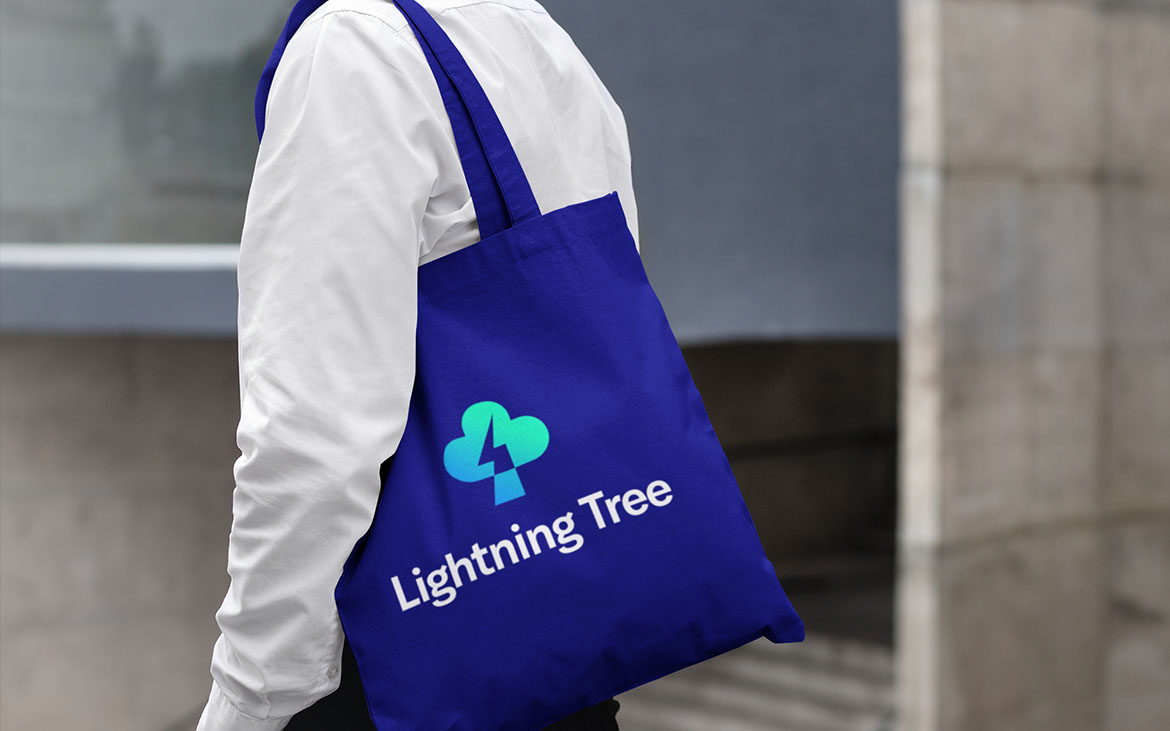
The logo below is one I designed recently for Lightning Tree, an early-stage deep-tech incubator. With such a descriptive name, a literal interpretation felt like the obvious starting point. The mark I arrived at reads simultaneously as a tree and as a storm cloud with a lightning bolt. Two ideas, one form, no compromise. The client signed it off first time after watching the journey presentation. It’s a good example of a project where presenting anything else would have made no sense… because this, to me, felt like the perfect solution.
Step 5: Show the Logo Across All Sizes and Applications
Then I begin the mockups, and this is crucial. I always show the logo at the full range of sizes it will realistically be used, because a logo presentation should demonstrate versatility, not just appearance.
I start large: an exhibition stand, a billboard, whatever is most relevant to that particular client. Then I work down through stationery, business cards, a pen, a favicon or app icon. The point is to demonstrate that the logo works at every scale, not just as a mark on a white page. Melissa Yeager makes this point compellingly: clients paying for a logo often can’t visualise how a mark will actually function in the world. Showing them removes that uncertainty and makes the solution feel real and complete.
Step 6: Record and Share via Loom
Rather than presenting live, which can create pressure and limit how freely clients can process the work, I record my logo presentations using Loom. I share my screen, talk through the slides, and deliver the same journey I’d present in person, but in a format the client can watch in their own time.
The benefits are significant. Clients can pause, rewind, and revisit the presentation. They can share it with colleagues or other decision-makers who weren’t in a live call. They can watch it when they’re in the right headspace to think carefully, rather than under the mild social pressure of a live presentation. And they get to hear my enthusiasm for the work, which, I’ve found makes a big impact.
Step 7: Act as a Consultant, Not an Order-Taker
After they’ve watched the recording, there’s an opportunity for feedback. But that conversation is structured differently now too.
Previously, when a client raised a concern or requested a change, I’d do exactly what they asked. I’d go away, implement their specific suggestion, and present it.
That’s not how I work any more.
Now I act as a consultant. If something isn’t working for a client, I want to understand their concern, but I don’t expect them to know the solution. That’s my job. I’ll listen to what’s bothering them, discuss it, and then offer my own recommendations for how to address it. I might agree with their concern and propose a different solution than the one they suggested. I might respectfully push back and explain why a particular choice was made. I guide them through the process rather than simply implementing instructions.
This shift is only possible because I’ve built up enough experience to trust my own judgement. With over 20 years in design, more than ten of them specialising in brand identity design, I’ve earned the right to have and defend a point of view. That’s not arrogance; it’s what clients are actually paying for. They’re not paying for execution. They’re paying for my expertise.
Has It Always Worked?
Honestly, not always. There have been projects where presenting a single logo concept didn’t land as smoothly as I’d hoped, and where I’ve had to rethink my approach mid-project. That’s part of the learning process, and it’s part of why I’ve developed tools like the intermediate step, to reduce the risk of investing significant time in a direction that fundamentally misses the mark.
But even when things haven’t gone perfectly, I’ve noticed that the quality of my design work has improved. When you commit to finding one answer rather than several adequate ones, you think harder. You question more. You push further. The design gets better because the process demands more of you.
A Final Thought
Presenting one logo is, at its heart, an act of professional confidence.
It says: I have listened carefully, I have thought deeply, and this is my considered answer to your problem.
It positions you as an expert rather than a supplier of options. It keeps the project focused on goals rather than preferences. And it removes the conditions that create the most common frustrations in client work: endless logo revisions, Frankenstein logos, and the uncomfortable feeling that the client is steering and you’re just holding the wheel.
I know this approach isn’t for everyone, and I know it takes a certain level of experience before you can genuinely trust your own judgement enough to commit to it. But if you’re a designer who’s reached that point, who usually knows which option is the strongest before the client says a word, then perhaps it’s time to stop presenting options.
Design is an iterative process. The iteration happens in your studio, not in the client’s inbox. Your job is to arrive at the one best solution, and then present it with conviction.
Frequently Asked Questions
How many logo concepts should I present to a client?
Most professional logo designers present between one and three concepts. However, a growing number of experienced designers, myself included, now present just one. When you’ve done thorough strategy work upfront and have the experience to identify the strongest solution, presenting a single, well-developed logo concept is almost always more effective than offering multiple options. It keeps the client focused on goals rather than personal preferences, and it positions you as the expert they hired.
What is the one concept approach in logo design?
The one concept approach, popularised by designer Sean McCabe in 2013 and practiced by designers including Paul Rand long before, is the method of presenting a single logo solution to a client rather than a range of options. The idea is that it’s the designer’s job to identify the most effective solution, not the client’s. Presenting one concept keeps the project focused, reduces revision cycles, and produces stronger results.
How do I present a logo to a client?
An effective logo presentation does more than show the finished mark. It takes the client on a journey: starting with the strategic thinking behind the direction, sharing early sketches and development work, then gradually revealing the logo, first in black and white, then in colour, before showing it mocked up across a range of real-world applications (from large-format signage down to business cards and favicons). Recording this presentation via a tool like Loom, rather than presenting live, gives clients time to watch, absorb, and share it with other decision-makers.
What should a logo design presentation include?
A thorough logo presentation should include: a recap of the strategic goals established in the brief; your reasoning for the chosen direction; early sketches or development work showing how the idea evolved; the logo in multiple configurations (symbol only, with wordmark, horizontal and stacked layouts); colour and black-and-white versions; and mockups showing the logo at various sizes and across relevant real-world applications. The presentation should tell a story, not just reveal a result.
Why do some designers only show one logo?
Designers who present one logo do so because it produces better outcomes for clients. Showing multiple options invites subjective comparison, encourages clients to cherry-pick elements from different concepts, and can lead to endless revision cycles. It also shifts the decision-making role from the designer (who has the expertise) to the client (who typically doesn’t). Presenting one well-considered solution keeps the project anchored to the original brief and treats the client relationship as a consultancy rather than a transaction.
Is the one concept approach right for every designer?
Not necessarily. It requires a strong strategic process, a solid client briefing system, and enough experience to confidently identify the right solution. If you’re earlier in your career and still developing your instincts, presenting two or three concepts can be a useful way to learn what works. But as your experience grows and your process matures, committing to a single direction, and defending it clearly, will almost always produce better work.
Ian Paget is a logo designer and brand identity specialist based in Birmingham, UK, with over 20 years of experience. He is the host of The Logo Geek Podcast, and the author of Make a Living Designing Logos. You can find his work and resources at logogeek.uk.